Wednesday, May 31, 2023

Literacy with an Attitude

 Literacy with an Attitude

Three Talking Points

1. "Today we see illiteracy among the have-nots as t he source of many social ills. ... We worry instead that the low levels of literacy among them makes them a liability for the rest of us. The idea is that if we could raise their level of literacy they would join the must haves" (p. IX). This stood out to me when I read it because it is the upper class, white people that made literacy only available to the rich and it got to the point that the rich have nothing to fear from the "have-nots" because the rich are the ones with the power. So even if they got the education they deserved, essentially they still would never reach the "elite" level.

2. "We were out there in the trenches and we took no advice from anyone who wasn't out there with us" (p.7).  "Don't be so damned superior! Don't look down your nose at people out there teaching real children in real and sometimes dreadful conditions" (p. 8). So these quotes stuck out to me as a teacher in general. EVERYONE wants to tell us how to be a teacher, how we shouldn't complain because our job is "easy", and so on, and it is ALWAYS people that are not teachers. It has nothing to do with race, gender, social class, etc., it is simply people see teachers as the bottom of the barrel and that it is easy. But like the first quote says, why listen to someone who has not been through and experienced what you have, whether it's teaching or other life experiences that people go through? The answer is you're not going to listen to them.

3. "American schools children of managers and owners are rewarded for initiative and assertiveness, while the children of the working-class are rewarded for docility and obedience and punished for initiative and assertiveness" (p.20). In America still different classes are held to different standards and typically its the lower classes that have lower standards except when it comes to behavior, they are reprimanded for doing everything. This is also true in just literacy itself, I took a course last summer on multicultural education and the statistics of Black Americans that are literate is so significantly and disturbingly low compared to white Americans. Because they are not the dominant race, people think they can't achieve the same standards that the white students can which is completely unfair and needs to change. 

Argument

Patrick J. Finn argues that a child's life should not be determined for them based on their socioeconomic status or where they live. All children deserve the same education, so they can have an equitable opportunities in creating a life that they want and being successful, not being forced to follow the expectations of people in the same class or location.


Equity Literacy for All - Inclusivity Institute

Wednesday, May 24, 2023

"Color Blindness is the New Racism"

Stop Saying "You're Colorblind," When You're Just Racist.

Articles

"Color Blindness is the New Racism"; Raising Awareness about Privilege Using Color Insight by Margalynne J. Armstrong & Stephanie M. Wildman

"Why you should stop saying "all lives matter," explained in 9 different ways by German Lopez


    Armstrong and Wildman discuss the issues that come from "colorblindness" throughout their work. Color blindness is the term that many white people use as a way to make it seem as though they accept people of all races, but in reality "Seeking colorblindness means Whites fail to see how whiteness has privileged them in so many societal interactions" (p. 66). So often white people don't even acknowledge race and the privilege and power that they hold just from being white. I know that I have heard white people, some that I know well, say they are colorblind. Before reading this text, I had some knowledge of what this term really meant, though I never took it upon myself to look into it more. Maybe that was the "luxury of obliviousness" that Allan Johnson discussed in his work "Privilege, Power, and Difference." I am now aware that I should have immediately looked up the term and corrected this person, who now I can truly see is a racist. Colorblindness essentially is a way for the dominant race, that being white, to avoid the separation and inequality of other races. Instead of colorblindness, the author's suggest as human's, specifically white humans, should utilize "color insight." "Color insight admits that most of us do see race and underlines the need to understand what the racial awareness might mean" (p. 67) and it "contrasts with colorblindness by offering an alternative that better serves the purported goals of colorblindness: racial equality and justice" (p. 68). 
    
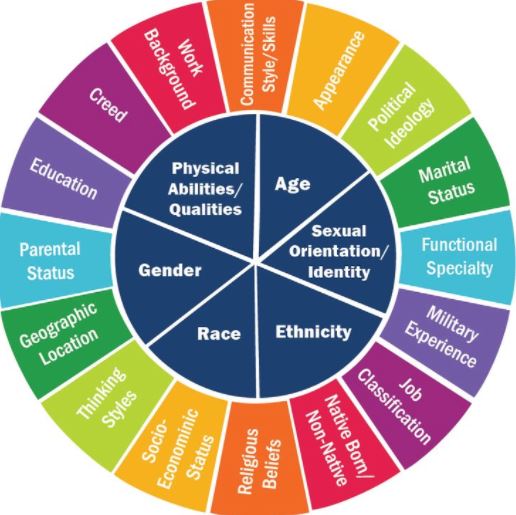
    Similarly to Johnson and Lisa Delpit's work, Armstrong and Wildman suggest that in order for change to happen regarding racial equality, white people need to be able to listen, understand, analyze, and discuss the experiences of non-white people along with the inequality that there is between races. One way of starting to do this is by looking at "The Diversity Wheel," as Johnson discusses (p. 18). By looking at this wheel, you can identify the areas that bring you privilege, whether it's race, gender, sexuality, socioeconomic status, etc. Armstrong and Wildman give the activity of using the "Power Line Chart" (p. 72) which is very similar to the Diversity Wheel, it looks at various descriptions that may place you above  the power line or below it, representing the different privilege one may have along with the oppression they may face. The authors state "No person is purely privileged or unprivileged; we are privileged in respect to some categories and not privileged in respect to others" (p. 71). 

The Diversity Wheel


As mentioned earlier, "Whites often do not think about race and racial justice, except when they notice people of color are present" (p. 66). Basically until there is someone that is not white around a white person, they don't acknowledge race because they are the "norm," the "dominant" race. So often white people get offended when the topic of race comes up because they don't see a need to discuss it as "All lives matter" (German Lopez, p. 1). Lopez goes on to give 9 different reasons why this just another example of white privilege and white people immediately misunderstanding what it really means when people say "Black Lives Matter." The phrase "Black Lives Matter" is not to say that black people are superior than other races, it is "simply pointing out that black people's lives are relatively undervalued in the US - and more likely to be ended by police" (p. 2). The fact that so many white people get so offended by this phrase just shows how much privilege and power they have along with ignorance and obliviousness. As a white person, it is uncomfortable to talk about race simply due to the fact I have to be part of this awful group of people who do awful things to non-whites. That's not to say other races don't do awful things, but it just shows that our country is still so stuck in the pre Civil War mindset that whites are superior, which just simply is not true. As white people we need to take accountability for the actions, violence, and inequality that WE have done, and look at how we can fix it. "Healing begins by listening to those voices and stories" of the non-white communities. If we are going to say "All Lives Matter" then actions need to show that this is true. Actions speak louder than words. 

Black Lives Matter is influencing artists, and they have our attention

Monday, May 22, 2023

The Silenced Dialogue: Power and Pedagogy in Educating Other People's Children

 The Silenced Dialogue: Power and Pedagogy in Educating Other People's Children

3 Talking Points

1. The people in power rarely ever acknowledge that they have power, similar to what Johnson said about privilege, and those who have no power are the most aware of the power others hold. "...those who are less powerful in any situation are most likely to recognize the power variable most acutely." (p. 26). "When acknowledging and expressing power, one tends towards explicitness...When deemphasizing power, there is a move toward indirect communication." (p. 27). People in power think that by being indirect it makes it easier to communicate and to lessen the power struggle, when in reality it amplifies it that much more. 

2. "The answer is to accept students but also to take responsibility to teach them." (p. 38). This is something that I have talked about in other courses and it seems so simple, but clearly it is not. Celebrating diversity is important, but it is the teachers role to have students embody and be proud of their culture, beliefs, etc., but it is also crucial that teachers teach how to function and how to live in mainstream America. There are untaught rules and codes that American's know because they are American, but these need to be explicitly taught to those coming from other cultures. It also creates a positive relationship between teacher and student when the teacher takes the time to learn about a student's culture, but also teach them how to function in America. 

3. "...it means turning yourself inside out, giving up your own sense of who you are, and being willing to see yourself in the unflattering light of another's angry gaze." (p. 46). This is so important and something that stuck out to me when reading Johnson, you can't truly ever understand what someone else experiences unless you also experience the same things, but you can being to listen, accept, and understand why people feel a certain way based on the experiences they have gone through. You need to be able to look at yourself through the eyes of someone else and analyze why they may be angry. She latter talks about the guidelines to take perspective of someone else and begin the dialogue, she states, "...we must learn to be vulnerable enough to allow our world to turn upside down in order to allow the realities of others to edge themselves into our consciousness. 

Argument 

Lisa Delpit argues that people hold different forms of power and in order for children and adults to be successful in the dominant culture, they must be explicitly taught the rules and codes while also preserving their native culture. 

Tuesday, May 16, 2023

Privilege, Power, and Difference

 Privilege, Power, and Difference
Allan G. Johnson

3 Talking Points:

  1. The quotes, "Can't we all just get along?" and "...a real and serious question, one that has haunted us ever since the Civil War..." really stuck out to me. It seems like such a simple question when it reality it is not. People don't want to discuss the issues that actually are happening, how it relates to them, and how to change it.
  2. "So instead of talking about the racism and sexism that plague people's lives, people talk about 'diversity' and 'tolerance' and 'appreciating difference.'" This was really eye opening for me because it is so true! Our country will try to look at any positive spin on serious issues that are going on and have been going on for centuries. It's great to find positives, but how about addressing the significant issues that are happening?
  3.  "When it comes to privilege, then, it doesn't really matter who we really are. What matters is who other people think we are, which is to say the social categories they put us in." 

Argument

Allan G. Johnson argues that without recognizing, understanding, and discussing others experiences, challenges, and perspectives in relation to our own, change will not happen.


Iowa Equity Challenge Day 5 | United Ways of Iowa
           

Learning & Development - The Diversity Wheel (NEA)

Taking it All Home

 Bringing it All Together Teaching at the Intersections by Monita K. Bell & 5 Tips for Being an Ally        I think both the article ...